
Charlotte County Federal Release Paths
No permanent federal prison was identified in Charlotte County. A federal defendant may still be housed in a state or local contract bed under U.S. Marshals Service authority. That person is not necessarily a Bureau of Prisons inmate. Before trial, a federal court may order release, detention, or conditions. After conviction, USMS may deliver the person to BOP. Later, BOP may record release from its custody.
Those stages lead to different destinations. A pretrial defendant may return to the community under court conditions, remain with USMS, or move to another contract facility. A sentenced person may enter BOP custody and later leave on the recorded release date, often with federal supervision still possible. Another government can also assume custody. “Released” must therefore be tied to the agency named in the record.
| Federal stage | Best release source | What it establishes |
|---|---|---|
| Federal pretrial custody | Federal docket and USMS record | Court authority and the Marshals Service custody action. |
| BOP sentence | BOP Inmate Locator | Covered federal custody and a displayed release date or location. |
| After BOP release | BOP historical result plus court record | Departure from BOP, not the end of all supervision. |
| Local Charlotte custody | Charlotte County Jail entry | Local release or transfer, unless federal authority is specifically recorded. |
Confirm Charlotte County Federal Release
Start with the case type. A state or local charge does not become federal because the person was transported, and a BOP no-result cannot answer a local-jail question. Find the federal case number, register number, or agency reference when possible. Then follow the record path that matches the known custody stage.
- Inspect the federal court docket for the detention, bond, judgment, sentencing, or release order.
- For pretrial USMS custody, use the docket first and request a specific USMS record when the public entry does not settle the custody action.
- If the person was committed to BOP, search the official locator by number or by name with its available filters.
- Read the BOP location and release date together. Do not interpret a date without its location label.
- If local Charlotte County custody appears in the history, request the source jail's release or transfer entry and identify the receiving authority.
- Check another custody system only when a destination or hold points to it.
The broader Charlotte County released inmate search explains how to separate county, state, federal, and immigration records when the original custodian is uncertain.
Note: “Not found in BOP” does not show that a federal pretrial defendant was released from USMS custody.
Charlotte County BOP Release Search
The BOP Inmate Locator covers federal inmate records from 1982 forward. It accepts a BOP register number and other listed federal identifiers, or a name search narrowed by age, race, and sex. A result can display the person's name, register number, age, race, sex, release date, and location. It applies after BOP involvement, not to every person held in a local contract jail.
The captured official BOP search form shows the federal locator route.
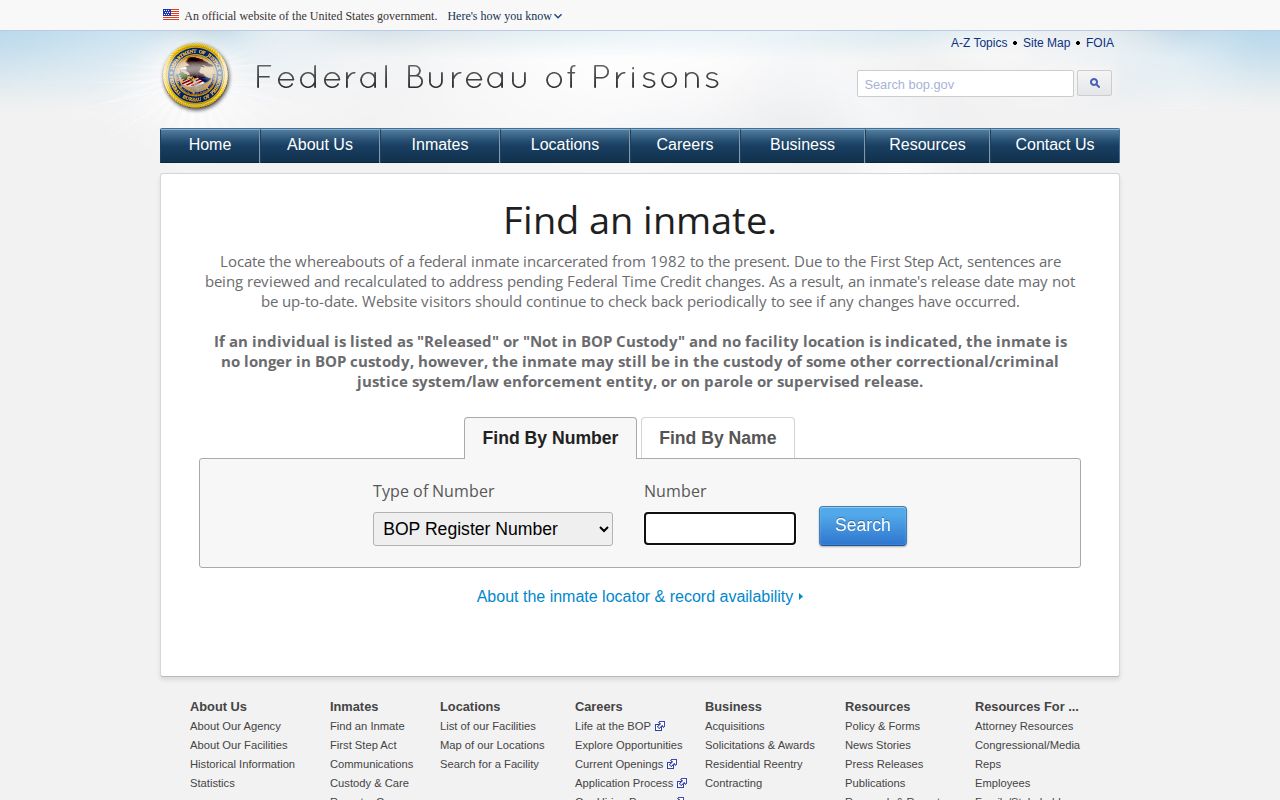
The form should be used only after the record supports BOP custody. A name-only match should be checked against the register number and case facts.
A past release date with no facility and a location of RELEASED means the person is no longer in BOP custody. It does not prove that federal supervised release ended, that another sovereign did not take custody, or that every case obligation ended. A future date is projected. A location of UNKNOWN means the confinement term is not determined, so it should not be presented as a fixed release plan.
Read Charlotte County Federal Results
BOP's official explanation of locator records is the source for interpreting dates and locations. The captured page below helps distinguish a historical released result from a current facility placement.
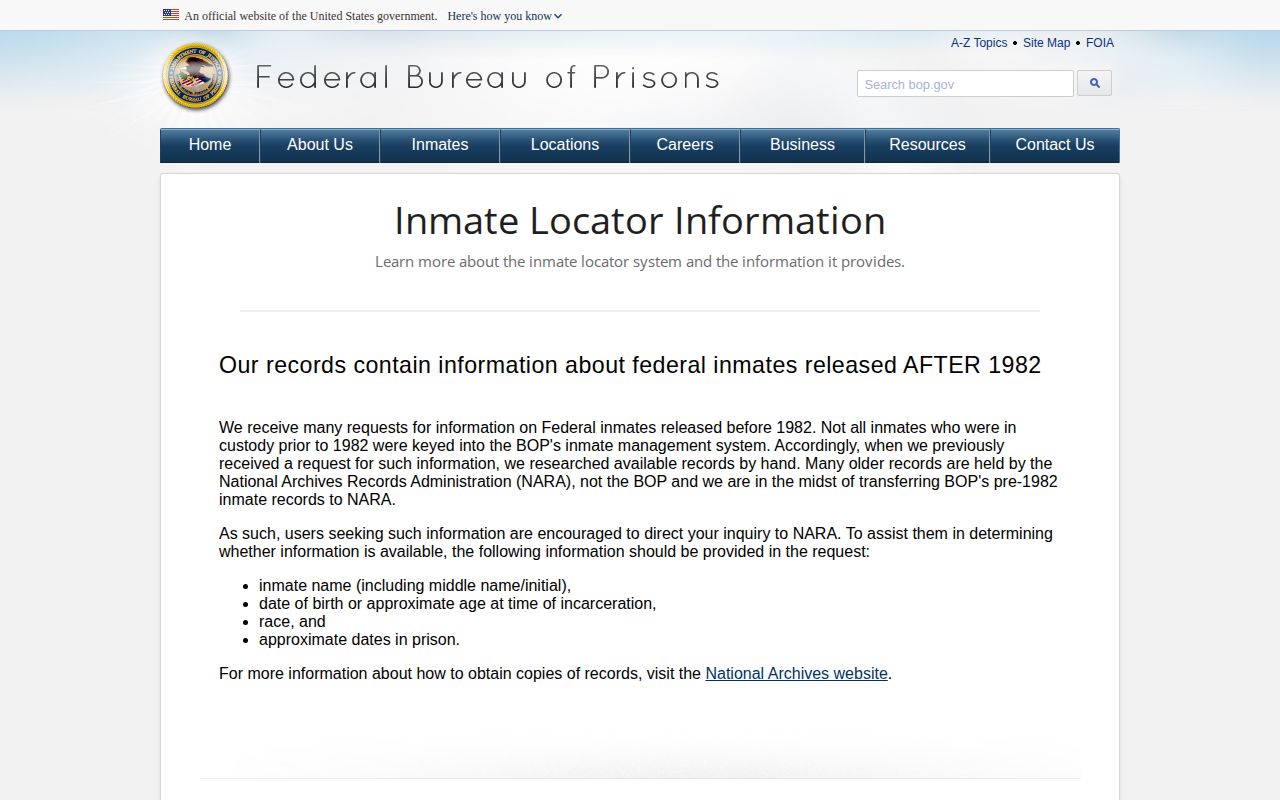
The interpretation rules keep a BOP departure from being overstated as freedom from all custody or supervision.
- RELEASED
- The person is no longer in Bureau of Prisons custody.
- Future date
- A projected date that may change and does not prove release occurred.
- UNKNOWN
- BOP has not determined the confinement term shown by the locator.
- Register number
- The federal identifier used to distinguish a person and record from similar names.
- Supervised release
- A court-imposed period after confinement that is separate from BOP prison custody.
Records older than the locator's coverage may require the National Archives. Even within the covered period, the court docket can supply the judgment and later supervision action that a short locator result does not explain.
Charlotte County USMS Release Records
The U.S. Marshals Service prisoner program manages federal defendants from court-ordered custody through acquittal or conviction and delivery to BOP. It may use local or regional contract beds. USMS has no public released-person locator. Its published policy also does not routinely provide personal histories, prisoner photographs, or arrival and departure times.
The federal court docket is therefore the first public source for a pretrial release. Look for a detention order, bond order, conditions, judgment, or later revocation. The docket records legal action but may not state the exact time USMS completed a physical movement. When that fact matters, submit a narrow request through the USMS Freedom of Information Act route. Identify the case, person, date range, and specific custody or release record sought. Law-enforcement and privacy exemptions can limit disclosure.
A court order granting release is authority for the next step, not proof of the moment a contract jail or USMS completed it. A separate hold, transport need, or agency handoff can change the actual path. Compare the order with any source-jail departure entry and the next custodian's record. This is especially important when a Charlotte County connection comes from the case rather than from a federal facility located in the county.
Charlotte County Jail Is Local
Charlotte County retains a small sheriff-operated jail next to Sheriff J. Randy Grissom's office. It is not a federal prison. The jail may hold a person for a local case, and the research also recognizes that federal authorities can use state or local contract beds. The authority shown on the commitment and transfer record decides which description is correct.
Nearby Piedmont Regional Jail is also not Charlotte County's regular jail. Its official member counties do not include Charlotte. Geography alone cannot redirect a Charlotte inquiry there, and placement there must be supported by an actual receiving record. The same rule applies to a supposed federal placement: use the named custodian, court order, and transfer entry rather than a nearby building or generic directory.
If Charlotte County Jail records release to USMS, local custody has ended while federal custody continues. If the record shows community release under a federal order, compare that action with the federal docket. If it shows release to ICE, move to the immigration custody route. Each handoff is a separate event.
ICE Handoffs After Federal Release
A federal custody result does not answer every later custody question. BOP explains that a location of RELEASED means the person is no longer in BOP custody, not that another government could not receive the person. When a Charlotte County case record, jail entry, or federal docket points to immigration custody, follow the named handoff rather than treating the BOP departure as community release.
An ICE detainer can request a local agency to maintain custody for up to 48 hours past the ordinary local release point so DHS can assume custody. That local rule matters when a federal defendant was held in a contract jail or moved through Charlotte County custody. The ICE locator then covers current detention and a limited recent-release period. Record the end of federal custody and the beginning or end of ICE custody as separate events.
Federal Custody Records and Contact
There is no Charlotte County federal prison address or public USMS release desk to list. Contact must follow the system involved. BOP provides the public locator for a committed federal inmate. USMS directs records requests through its federal FOIA process. The federal court that issued the order maintains the public docket and court filings. A local jail contact applies only when the person was physically held there and its record can show the transfer.
BOP: use the official Inmate Locator
USMS: use the agency FOIA request route
Federal pretrial release: inspect the issuing court docket
Charlotte County Jail transfer confirmation: 434-542-5141
Do not send sensitive personal details until the receiving office and method are confirmed. A precise request seeks an existing document, not a new explanation or custom timeline.
For a BOP record, include the register number when known because it is more precise than a common name. For a USMS request, include the court and case number as well as a narrow date range. If Charlotte County Jail supplied a contract bed or transfer stage, direct the local portion of the request to that jail and ask for the receiving authority. One office cannot be expected to certify another agency's later release.
Preserve Charlotte County Federal Proof
A sound federal release account can require more than one record. The court order explains legal authority. A USMS response can address a pretrial custody action. A BOP result can show a release date and released location after BOP commitment. A source-jail transfer entry can show when the person left local physical custody and which agency received them.
Keep the source, access date, identifier, and exact status text. Do not treat a projected BOP date as completed release. Do not treat BOP's RELEASED location as the end of court supervision or custody held by another agency. Those limits are part of an accurate Charlotte County federal custody record.
When records conflict, favor the document created for the event being verified. The court controls the legal order, the source jail controls its departure log, USMS controls its custody record, and BOP controls its locator entry. A sequence built from those sources is more reliable than forcing one locator to answer every federal release question.