
Charlotte Projected and Actual Release
A projected date is a calculation made before custody ends. It may reflect the active sentence, jail-time credit, an earned-credit class, and other sentence data known at that moment. Actual release is the later event when the responsible agency completes the order and records the person as leaving its custody. A date can be correct when computed and still change before that event.
For VADOC facilities, the facility release process provides the stronger completion evidence. The person and a staff witness sign and date an Order of Release or applicable probation or parole conditions. VADOC says departure occurs no later than 11:59 p.m. on the scheduled date, weather permitting. That is a state-facility rule. Charlotte County Jail has not published an equivalent deadline, so it cannot be applied to the local jail.
Scheduled versus actual: A future date is a time-sensitive computation. A signed release order, jail release entry, or confirmed custody event proves the later departure.
A pretrial detainee is different. There may be no sentence to compute. Bond, recognizance, dismissal, a court release order, a detainer, or the next hearing can control what happens. The Charlotte General District Court or Charlotte Circuit Court record explains the authority, but the Charlotte jail entry supplies the release time and whether the event was community release or transfer.
Find a Charlotte Inmate Release Date
The search path turns on legal custody, not just the building. A person can remain physically in a local or regional jail while VADOC has responsibility for time computation. Begin with the commitment and sentencing order. Determine whether the case is pending, whether a local sentence controls, or whether the person is state responsible. Then use the source tied to that status.
- Check the Charlotte court case for disposition, active sentence, suspended time, and jail credit.
- For a local sentence, call Charlotte County Jail at 434-542-5141 and ask which office computes the date.
- For state custody or supervision, open the VADOC Inmate and Supervisee Locator.
- Search with a seven-digit DOC ID, or use the full last name and at least three first-name letters.
- Read the correctional status and location, then note the access date because the system updates daily.
- Request the underlying computation or inactive record when a current result does not settle the question.
The exact date label shown on a live VADOC result was not verified in the research. Do not assume that the interface calls it “Projected Release Date” or “Tentative Release Date.” VADOC procedure does support public confirmation, on written request and subject to limits, of projected parole-eligibility, mandatory-parole, and good-time release dates as of the date of inquiry.
Note: A no-result from the current VADOC locator does not prove discharge, and a facility result means the person remains confined.
Who Computes Charlotte Release Dates?
This is Charlotte County's key computation issue. VADOC explains that responsibility changes with sentence type and active time. Local authorities calculate many short or local sentences. VADOC calculates qualifying state-responsible time. Physical location can lag legal responsibility, so seeing someone in a local jail does not answer who owns the calculation.
Code of Virginia section 53.1-116 requires the jailer to maintain the commitment record and a written local earned-credit policy. Charlotte County Jail has not published its policy online. A sound local request asks for the policy that applied to the person, the recorded sentence-credit calculation if releasable, the admission and release timestamps, and the executed release order or log entry.
VADOC's own time-computation source shows the state framework. Review the official VADOC time computation page before using the image.
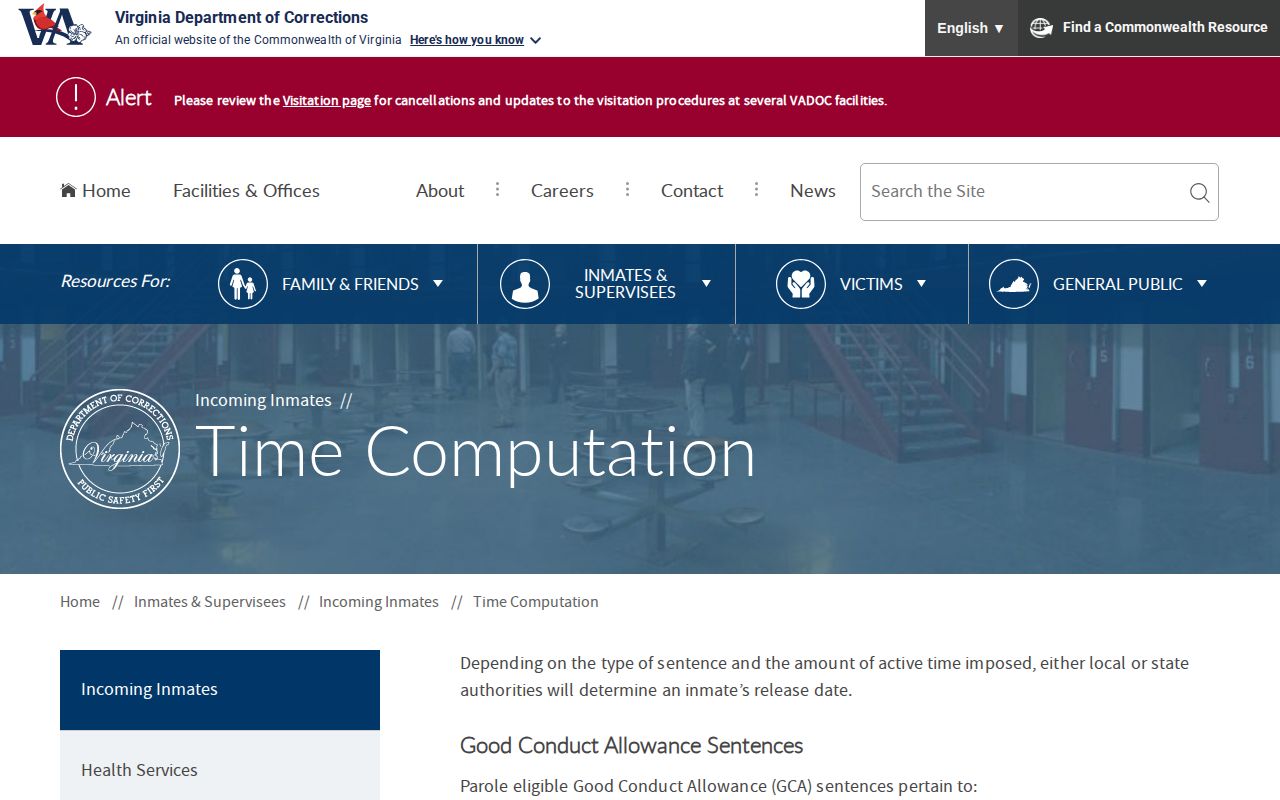
The source separates Good Conduct Allowance sentences from Earned Sentence Credit sentences and helps determine which rules govern a state calculation.
Can the VADOC formula be used for every Charlotte jail sentence? No. Obtain the local policy and identify the responsible timekeeper before making any estimate.
Charlotte Release Dates and Credits
Virginia uses more than one credit framework. VADOC describes Good Conduct Allowance for felony offenses before January 1, 1995 and misdemeanor offenses before July 1, 2008. Depending on the qualifying sentence, those rules may involve discretionary-parole eligibility, mandatory parole, and good-time release. GCA classes can award from zero to 30 days for each 30 days served.
Earned Sentence Credit generally governs felony offenses committed on or after January 1, 1995. Under section 53.1-202.3, enumerated serious offenses are capped at up to 4.5 days of credit per 30 days served. Eligible subsection B sentences can earn up to 15 days per 30 at Level I, 7.5 at Level II, or 3.5 at Level III. Offense limits and the assigned class control.
The common “85 percent” shorthand is not exact. At the restrictive maximum, 30 days served plus 4.5 credit days satisfy 34.5 sentence days, which is about 86.96 percent physical service. Expanded-credit categories, mandatory minimums, excluded offenses, pretrial credit, consecutive or concurrent sentences, and later corrections make a single percentage unsafe. Conduct and program cooperation can affect classification, while section 53.1-202.4 governs earning and forfeiture criteria.
- Active sentence
- The incarceration time ordered for service, apart from suspended time.
- Jail credit
- Qualifying time already spent in custody that is applied to the sentence.
- Earned credit
- A statutory reduction tied to the controlling offense rules, class, conduct, and other criteria.
- Mandatory minimum
- A term that statutes require to be served without ordinary credit reductions.
Charlotte Jail Good-Time Policy
Local jail credits need their own review. Unless a mandatory minimum controls, section 53.1-116 provides that a person sentenced to 12 months or less for a misdemeanor or qualifying combination can earn one good-conduct day for each day served during compliant time. Qualifying presentence time can count. A jailer may also award five extra days per 30 for eligible work, classes, or programs if those options exist under the written policy.
Violations can restore time that had been deducted. Program availability also matters. Since Charlotte's written policy was not found online, no individual local release date should be calculated from the statutory ceiling alone. Ask for the policy version in force during the sentence and the actual calculation entry. That is more reliable than importing a state-prison percentage into a local case.
A concise request can identify the person, booking or case number, sentence date, jail-credit amount, applicable credit policy, computed date as of a stated day, and any later adjustment. The office need only supply existing records. It does not have to create a new analysis or answer a hypothetical calculation.
Note: Charlotte County's unpublished local policy is the missing piece, so call the jail before relying on a pickup date.
Why Charlotte Release Dates Change
A projected date represents the facts then entered. Credited jail time, active sentence length, offense type, earning class, discipline, and sentence structure can all shift it. A court correction may revise the legal foundation. A new sentence can add active time. Parole action can create or remove a conditional route, while a hold from another authority can change where the person goes when one agency's custody ends.
| Factor | Possible effect | Best confirming source |
|---|---|---|
| Jail-time credit | Moves the computed balance when credit is added or corrected | Sentencing order and time computation |
| Earned-credit class | Changes the rate at which eligible sentence days are satisfied | VADOC or local calculation record |
| Disciplinary event | Can reduce or forfeit eligible credit | Agency computation and disciplinary record |
| Court correction | Changes active time, concurrency, or credit | Signed court order |
| Parole decision | May authorize conditional release but not immediate departure | Board report and later release record |
| Detainer or transfer | Ends one custody stage without release to the community | Release entry and receiving agency |
Virginia generally abolished discretionary parole for post-1994 felony offenses under section 53.1-165.1, but the statute includes current exceptions. Earned credit does not create parole eligibility. Those are separate legal paths and should not be blended in a date estimate.
Confirm Charlotte County Actual Release
For Charlotte County Jail, call 434-542-5141 and ask whether the recorded event was release to the community or transfer. If documentation is needed, request the existing release-log or custody-history entry, the release date and time, release classification, authority, and destination or receiving agency. Pair that entry with the court order. A court ruling can explain why release was authorized without showing the exact time processing ended.
For state custody, use the latest VADOC status and the executed release paperwork. If a person has left secure custody but remains on state parole or probation, the locator may point to District 24 Farmville. A person no longer in the current locator may require the notarized inactive-record route described by Operating Procedure 050.1. The underlying VACORIS record continues after public current-custody display ends.
Virginia Jail VINE can supply a fast local release or transfer notice, but it does not promise a lasting released profile. Register before the expected event when possible. The Charlotte County VINELink Release Check covers the alert process. Preserve the alert wording, agency, and time, then confirm an unclear transfer with the source jail.
The Charlotte County release-record search path also separates local, state, federal, and immigration custody. That distinction is essential when one agency records a release but another immediately assumes custody.
Charlotte Release-Date Record Requests
A dated record request is useful when a future computation has changed or disappeared from a live system. For a Charlotte local sentence, address a reasonably specific request to Sheriff J. Randy Grissom's office at the Charlotte County Sheriff's Office, 222 Law Lane, Charlotte Court House, VA 23923. The official jail page gives facility information but no online release-record form, named records officer, fee schedule, or records email. Call 434-542-5141 first to confirm the current submission method and ask where written requests are accepted.
Name the existing documents and fields. Ask for the commitment entry, admission date and time, sentence or court authority, credited time, recorded release calculation if releasable, changes to that calculation, release date and time, release classification, receiving agency if transferred, and any executed release order. Include a booking or case number when available. A narrow date range reduces confusion and possible search cost.
Under Virginia FOIA section 2.2-3704, covered agencies generally have five working days to choose a statutory response, with extension mechanisms and reasonable actual charges allowed. Ask for an estimate before costs exceed a stated amount. The agency supplies existing records and need not create a new computation just to answer a question.
For an inactive VADOC record, Operating Procedure 050.1 identifies notarized form 050_F17. Its published charges include $0.10 per page or copy, actual postage or shipping, and reasonable actual labor for extra archival research. Request the computation as of the relevant date, along with actual release or discharge documentation. Comparing two dated computations can show what changed without treating either older projection as the completed release.