
Charlotte County Three-Day Release Sources
Sheriff J. Randy Grissom's official Charlotte County Sheriff's site had no distinct 72-hour view, current custody roster, or release archive when checked on August 8, 2026. No feed URL, field list, update cadence, or retention rule can be quoted. A reader looking back over three days must reconstruct the period from event notices and records held by the agencies involved. That is different from reading a ready-made list.
Virginia Jail VINE is the fastest local-jail channel. It covers all Virginia local and regional jails and supports release and transfer notices. A saved notice can help place an event inside the three-day period. The jail record then provides durable proof and may show a timestamp, release authority, type, and destination. Finally, a court docket or signed order explains the legal action behind a bond, dismissal, sentence, or probation term. None of those sources should be stretched beyond what it records.
Review Charlotte County 72-Hour Releases
Define the three-day interval first. Note the start and end date and the local time zone, especially when the period crosses a weekend. A request for all releases may seek a report the jail does not maintain. A narrower request for existing release-log entries during stated dates is more precise, though the agency is not required to build a new database or answer questions.
- Search VINELink under Virginia for the specific person and verify that the facility is the right Charlotte County or other Virginia jail.
- Review any notice received during the period. Keep the event time and wording, including whether it says release, transfer, or another custody change.
- Call Charlotte County Jail at 434-542-5141 and give a name plus the booking or case number when known.
- Ask for the existing custody-ending entry within the defined dates, including release time, classification, authority, and destination if recorded.
- Check the official Virginia court case for a matching bond, dismissal, sentence, credit, or other order.
- Move to VADOC, BOP, USMS, or ICE sources only when the case or transfer record points to that custody system.
A same-day question may be handled more directly through the Released Last 24 Hours path. For a named person or older record, use the full Charlotte County release search. The three-day method is most useful when an event date is uncertain, several days have passed, or a weekend separates the last confirmed custody check from the current one.
Note: Record the agency, access date, exact status words, and identifier without keeping unrelated personal details.
Charlotte County Weekend Release Review
A 72-hour span often crosses Saturday or Sunday. That does not create a special Charlotte County release schedule. The Sheriff's jail page publishes visitation times, but it does not state release-processing hours, weekend rules, holiday rules, or a guaranteed exit time. VADOC's state-prison discharge rule cannot be borrowed for the county jail. Call before arranging travel or pickup.
Court action and jail processing also occur on separate timelines. A signed release order may precede the moment jail staff finish identity checks, property return, paperwork, and hold review. Another agency's detainer can change the destination. For that reason, compare the order date with the jail timestamp instead of assuming both occurred at once. If the court event occurred before the three-day window but the jail event fell inside it, the jail record answers the recent-release question.
Holiday closure at a public counter does not establish that custody processing stopped. It only affects access to staff or records. An alert may arrive while a clerk's office is closed, and documentary confirmation can follow on the next working day. State no release until an event source supports it.
Charlotte County 72-Hour Record Fields
There is no verified online Charlotte field display to reproduce. Instead, a three-day request can seek the existing custody entries that fall within a fixed date range. The following fields come from the Charlotte release-record inventory and should be requested only if maintained. Some material can be withheld or redacted under criminal-record, sealed-record, juvenile, security, medical, privacy, or court-order rules.
| Field | Use in a 72-hour review |
|---|---|
| Full name and booking number | Separates people with similar names and ties the event to one booking. |
| Booking or admission time | Defines the custody episode, even if it began before the window. |
| Release date and time | Places the jail's action within or outside the chosen three days. |
| Classification or reason | May distinguish bond, court order, time served, completion, or transfer. |
| Releasing authority | Points to the court or legal instruction behind the action. |
| Destination or receiving agency | Shows whether the person entered the community or another custody system. |
Ask where written Virginia FOIA requests are currently accepted before sending sensitive identifiers. The Charlotte County Sheriff's Office posts no release-record form, email address, or fee schedule. Virginia law generally gives covered agencies response choices within five working days and permits reasonable actual charges, with extension procedures. Request an advance estimate and electronic copies when available. A date-bounded request can reduce search work without asking the jail to create a custom list.
Charlotte County Has No Roster Archive
The lack of a roster creates a special data issue in Charlotte County. A person cannot be described as having “fallen off the Sheriff's roster” because the Sheriff does not publish one. Likewise, an empty recent-release page cannot be offered as proof that no one left custody. There is no county page from which to draw either conclusion.
The official Charlotte County Jail page describes the facility but does not offer a release search. Its captured view provides context for the online gap.
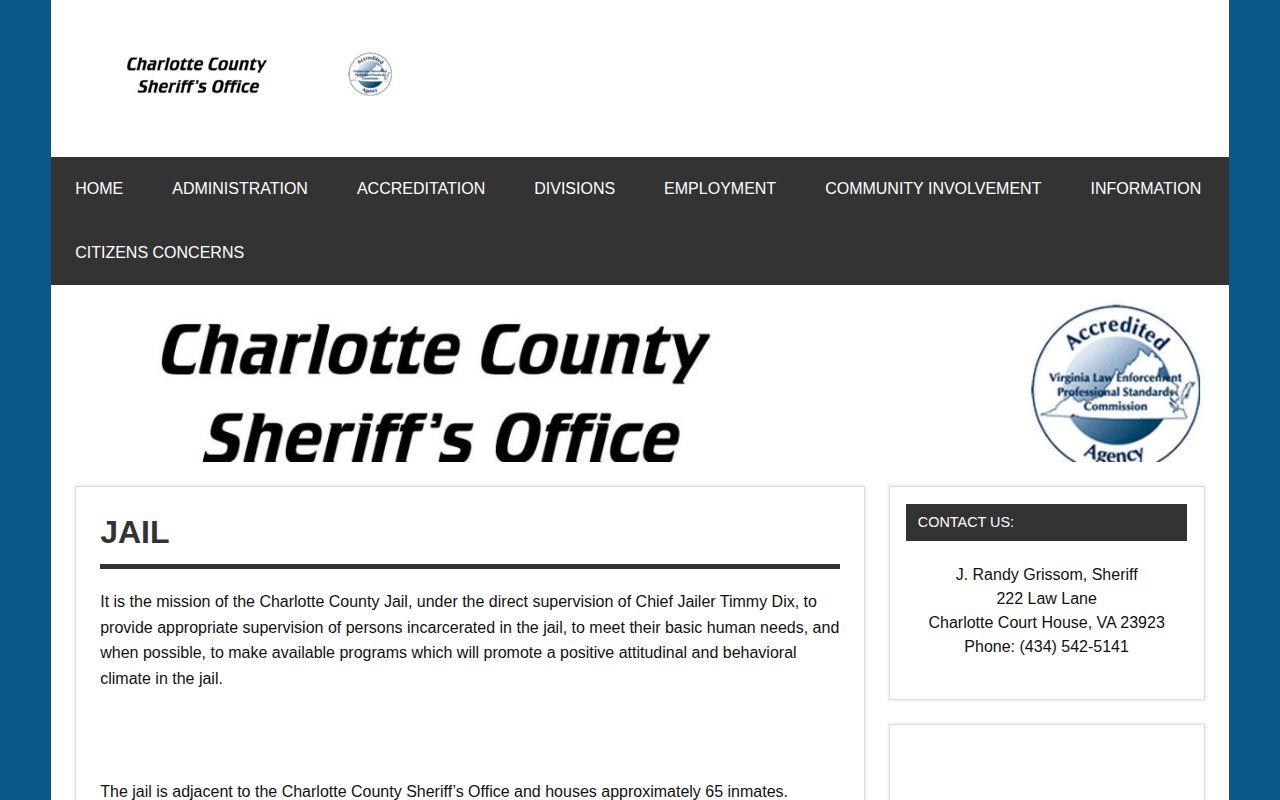
The image documents the official source reviewed, not the absence of releases. VINE, direct jail records, and the court remain the correct routes.
Press releases and official social posts are also selective. They can supply a case narrative, date, or photo, but they do not document every custody event. A person not mentioned in the news may still have been released, transferred, or kept in custody. Treat those channels as leads only.
Historic Sheriff annual reports do not solve the gap. They publish activity totals for past years, but not the number of releases, a person-level release log, average stay, or a rolling three-day count. An arrest total cannot be converted into a release total. For a Charlotte County 72-hour question, only the dated custody entries and notices from the relevant period can support the answer.
Classify Charlotte County Custody Changes
The three-day window matters only after the custodian is clear. Charlotte County Jail is a local sheriff-operated jail. VADOC controls state prison custody and state community supervision. USMS may hold a federal defendant in a contract bed before BOP commitment. ICE can take custody after a local jail event. One search system does not cover all four paths.
| Event | Next source | What the result means |
|---|---|---|
| Local community release | Jail entry, VINE notice, court case | Charlotte County custody ended without a named receiving jail. |
| Virginia jail transfer | Source entry plus receiving-jail VINE status | The person left one jail but remained confined. |
| VADOC authority | VADOC locator or records request | Current state custody or supervision may continue after local departure. |
| Federal transfer | Federal docket, USMS record, later BOP locator | BOP may not show a federal pretrial detainee. |
| ICE transfer | Jail destination plus ICE locator | Release from local custody may still mean immigration detention. |
The VADOC locator updates daily and may be inaccurate or outdated. It covers current custody and supervision, not every old county release. BOP preserves a historical released result for covered federal inmates from 1982 forward, while ICE's locator has a limited recent-release period. These tools help only after a record points to the matching system.
Note: A transfer ends one agency's custody but does not show that the person returned to the community.
Preserve Charlotte County Release Proof
A saved VINE notice is useful because it gives the recipient a timestamped event in a chosen delivery channel. It is not the whole record. The jail's existing release entry, the signed court order, and any receiving-agency record are better long-term evidence. Court records may stay available after live custody data changes, subject to system coverage, confidentiality, sealing, and retention rules.
Request only what is needed. Full name, sufficient identifiers, booking date, booking number, and case number can help locate the correct event. Ask whether the disposition was community release or transfer. If it was a transfer, ask for the receiving agency or facility as recorded. That wording makes a three-day review more accurate and avoids turning an agency's lack of a generated report into a false claim about releases.
For an older event, the court case may remain available after live jail information changes. A VADOC inactive record can also preserve state history when state authority followed the Charlotte County case. Those are historical routes, not substitutes for a local release timestamp. Keep each source tied to the agency that created it and note when it was checked.